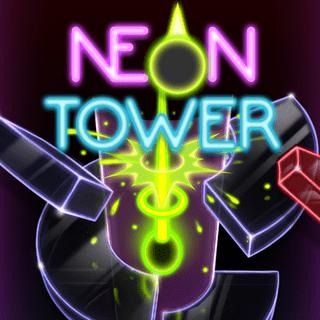
Most people lose at Neon Tower somewhere between floor fifteen and floor thirty. Not because their reflexes give out, but because the tower has already narrowed so much that a single late tap ends the run. The neon block-stacker looks like a pure reflex test, and for the first ten floors it is. After that it becomes something else entirely: a rhythm game disguised as a stacking game.
This guide covers the timing model behind the sliding blocks, the recovery habits that keep a wobbly tower alive, and the practice pattern that moves your average run from twenty floors to something worth screenshotting. Everything here is about the version of Neon Tower on this site - one tap to drop, no power-ups, no ads breaking your concentration.
How Neon Tower Works
A block slides horizontally above your tower, changing direction each time it reaches the edge of the play area. You tap once to drop it. Where it lands decides everything: a pixel-perfect drop keeps the tower at full width and adds a small speed bump to the next block, while any overhang gets sliced away. Slice too much and the tower becomes a needle, at which point the next slightly-off tap is fatal.
The difficulty curve comes from two dials that move together. Each successful drop makes the next block slide faster and shortens the distance it travels. So the window for a perfect hit shrinks in both time and space. That is why the game feels calm at floor five and frantic at floor forty - the same tap that felt generous early on becomes a precision strike later.
There is one mercy built in: the slice only removes the overhang, not the whole block. A sloppy drop does not kill you, it just makes every future drop harder. That distinction matters, because it means the recoverable error and the run-ending error are completely different things.
Nine Timing Tricks That Actually Work
1. Tap on the block's centre, not its edge
Aim to release when the centre of the sliding block lines up with the centre of the tower. Beginners watch the leading edge and tap when it clears the tower's far side, which produces a consistent overhang on one side. Centres are easier to judge than edges because the block's middle stays stable while its silhouette changes with speed.
2. Let your thumb hover with a gap
Resting your finger on the screen before the drop adds a fraction of a second of travel time. Hold your thumb a centimetre above the display and tap downward instead. On a mobile screen that gap is enough to change a miss into a clean hit, and it also prevents the accidental double-tap that drops two blocks in a row.
3. Watch the tower, not the block
Your eyes should be fixed on the top of the tower, not on the block sliding above it. The tower is stationary, so the target reference costs nothing to track, while a moving block forces your eyes to constantly re-aim. Players who stare at the block consistently drop early because they react to motion instead of anticipating position.
4. Convert the slide into a beat
Every block takes the same amount of time to cross the screen, so the back-and-forth motion has a steady tempo. Count it in your head as a two-beat cycle - left, right, left, right - and tap on the beat that matches the tower's position. This is the same mental trick that makes Piano Fire playable at high speed: once the rhythm is internal, your timing stops depending on visual tracking.
5. Protect width over height early
In the first ten floors you should refuse to lose width at all. The blocks are slow and wide, so perfect drops are easy, and every pixel you preserve now pays compound interest later when the window shrinks. A player who reaches floor fifteen at full width is effectively playing a different, much easier game than one who arrives at floor fifteen already down to two-thirds.
6. Accept one deliberate save
If you are already going to miss, deliberately aim so the overhang is small. A tap released slightly late will slice a thin sliver; the same tap released early can remove a third of the tower. When you feel the timing slipping, make the conservative error. There is no reward for a dramatic save, and the tower only ever gets narrower.
7. Reset your grip at every five-floor mark
Hand tension accumulates and quietly wrecks precision. Every five floors, take your thumb off the glass for a beat, relax your hand, and re-set your hovering position. The pause costs nothing because the block only starts moving again when you are ready, and the reset prevents the fine tremor that shows up in long runs.
8. Practise in short sets, not long grinds
Neon Tower is a precision task, and precision degrades fast. Three runs of two minutes with a short break in between will build better timing than one continuous fifteen-minute grind, because the last ten minutes of a long session teach your hand nothing except fatigue. Treat each run as a set, then step away.
9. Replay the exact floor you died on
Your failures cluster around specific floor numbers, because the speed step at each block is fixed. When you die, note the floor, restart, and treat the next run as deliberate practice for that specific speed. This targeted approach is how players get past a plateau - the same rapid-iteration method that works in Drift Dudes, where one corner, not the whole lap, is usually the problem.
Common Mistakes That End a Run Early
Almost every short run shares one of these patterns:
- Reacting instead of anticipating. If you tap when the block looks aligned, you are already late - the block keeps moving while your finger travels. Aim for where the block will be.
- Watching your score. Looking away from the tower for a single drop is enough to lose width.
- Panicking after the first slice. Players whose tower narrows start tapping faster and sloppier, which is exactly backwards - narrow towers need calmer, more careful taps.
- Chasing a perfect run too early. Restarting the moment you lose one pixel teaches you nothing. Practise recovery instead; the tower is far more forgiving than it looks.
- Playing with the volume off. The neon pulse and the music both shift with each successful drop, and they are free timing cues. Muting the game removes information you are not paying for.
Frequently Asked Questions
Is Neon Tower a reflex game or a timing game?
It starts as a reflex game and becomes a timing game. Below roughly floor ten you can survive on reactions alone. Past that, the blocks move faster than a visual reaction loop can reliably track, so players who keep improving are reading the rhythm and anticipating the drop rather than responding to it.
How high can an average player get in Neon Tower?
Most first-session players land somewhere in the twenties. With the centre-tapping and rhythm habits from this guide, consistent runs in the forties and fifties are realistic within a week of short daily practice. Beyond that the tower has usually narrowed enough that a single imperfect drop decides the run.
Does Neon Tower have levels or an ending?
No. It is an endless high-score game - one tower, one tap, no level select. That is also why it works well as a browser break: a run lasts as long as you can hold your timing together and nothing has to be saved or resumed.
What should I do if the tower gets very narrow?
Slow down and aim for centres with extra care, and accept that you are now playing for survival rather than height. A narrow tower with ten careful drops is worth more than a reckless attempt at speed. If the tower is down to a sliver, expect the run to end soon and use it as practice for the next restart.
What to Play Next
If the anticipation skill in Neon Tower suits you, Piano Fire pushes the same rhythm-reading muscle much harder, and Ball Sort Master swaps reaction speed for the calm, rule-based thinking that keeps a long run alive. Both sit next to Neon Tower in the free puzzle games collection, along with slower stacking and sorting titles such as Cubito and Word Swipe - useful when you want the shape of a stacking game without the rising speed.