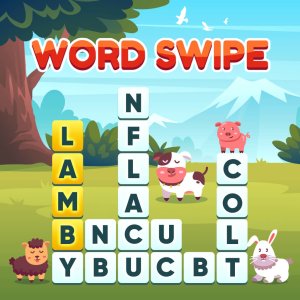
Word Swipe takes the quiet, pencil-and-paper word search you remember from newspapers and gives it a jolt of momentum. Instead of circling words with a pen, you swipe across letters on a grid, and every word you find collapses: the remaining letters tumble downward and reshape the board in real time. It is a small mechanical change with a big effect: no two boards play out the same way, and a puzzle that looks finished can suddenly open up with one clever find.
You can play Word Swipe free in your browser at minigameport.com, with no download and no install. If you have bounced off static word searches before, or you keep getting stuck on the final word of a board, this guide covers how the game works, then eight practical tips, the mistakes most players make, and quick answers to common questions.
How Word Swipe Works
Every board is built around a theme. Your job is to find all of the hidden words connected to that theme, which are scattered through a grid of letters. Words can run horizontally, vertically, or diagonally, and you spell one out by swiping across adjacent letters in order.
The twist is what happens after a match. When you find a word, those letters vanish from the board and the letters above them fall down to fill the gap. That falling-letter mechanic is the heart of the game: clearing one word reshuffles the geometry of the grid and can line up entirely new letter paths, sometimes completing a second word without you touching it.
A hint system reveals the first letter of one hidden word, and the board is only cleared when every theme word has been found. Success therefore blends three skills: vocabulary for theme words, pattern recognition for spotting letter sequences, and planning for how the board will change after each find.
8 Word Swipe Tips to Clear Boards Faster
1. Read the theme first, scan the grid second
Most players drop straight into letter-hunting, but the theme is the most useful information on the board. Before you trace anything, spend a few seconds generating candidate words. If the theme is weather, you are looking for terms like rain or storm, not random letter runs. Holding five or six candidates turns a blind scan into a targeted search, because your eyes find specific letter shapes far faster than generic sequences.
2. Hunt the longest words first
Long words are worth more than their length. Each one you clear removes a large block of letters at once, which triggers the biggest cascades and reshuffles the most of the board. That reshuffle frequently creates fresh opportunities, so an early long word can unlock a chain of easier finds. Scan deliberately for the longest candidate from your theme list first, and only fall back on three- and four-letter hunting once the obvious long words are gone.
3. Sweep corners and edges early
Corner and edge letters are the easiest to overlook and the hardest to use late in a board. A letter in the corner connects along only two directions, and diagonal paths that pass through corners are easy to miss entirely. As the board empties, those isolated letters become the last obstacle. Make it a habit: after your first pass for long words, run a slow lap around the perimeter of the grid and check every corner for short theme words.
4. Plan for the fall, not just the find
Because letters drop after every word, the board you see is only temporary. Before committing to a swipe, glance at what sits above your target word. If clearing it will drop a useful cluster into the middle of the grid, the move is doing double duty. Conversely, clearing a word at the very bottom barely changes anything. Players who think one move ahead, find, fall, then look, clear boards with fewer hints than those who treat each word as an isolated event.
5. Trace diagonals on purpose
Diagonal words are the most underused resource in Word Swipe. Horizontal and vertical sequences pop out naturally because your eyes are trained to read in rows, but diagonals require a deliberate shift in attention. When you feel stuck, pick one promising starting letter and trace all eight directions from it one at a time. This systematic check takes seconds and routinely surfaces diagonal theme words that two or three casual scans missed completely.
6. Stretch finds with prefixes and suffixes
Word games reward the endings. When you spot a theme word inside the grid, check whether an S, D, or G sits adjacent to its last letter, because plurals and -ing forms extend your find and clear extra letters for free. The same works at the front of the word, where common openings can quietly turn a word you already found into a longer one. This habit matters most late in a board, when remaining letters are scarce.
7. Anchor on rare letters
High-frequency letters like E, A, and R appear everywhere, which makes them poor anchors when you are stuck. Rare letters such as X, Z, Q, and J are the opposite: they appear in few words, but almost every word containing them belongs on your theme list. If a rare letter is on the board, there is a strong chance it is part of a hidden word. Find it, then work outward through its neighbors to reconstruct the word around it.
8. Save hints for genuine dead ends
The hint system reveals only the first letter of one word, so it is a nudge, not an answer key. Spend it too early and you waste its value on a word you would have found anyway. The right moment is after a full systematic pass: theme brainstorm done, long words cleared, perimeter swept, diagonals traced from rare letters, and one word still missing. Even then, make it work harder: instead of hunting the revealed letter, ask which theme words start with it and search for their second and third letters nearby.
Common Word Swipe Mistakes to Avoid
- Hunting letter by letter without using the theme. Random scanning is the slowest approach; the theme tells you which words actually exist.
- Ignoring diagonals. Most missed words hide on diagonal paths, precisely because everyday reading trains your eyes to move in straight rows only.
- Spending a hint in the first minute. An early hint answers a question you were about to solve yourself, and you will want it more when the board is nearly empty.
- Forgetting that the board changes. Staring at a stale mental map after three cascades is a classic trap. Re-scan the grid after every fall, because the word you need may have just moved into view.
- Tunnel vision on one missing word. If a word refuses to appear for more than a minute, look away and clear something else. Fresh eyes, and a reshuffled board, usually finish the job.
Word Swipe FAQ
Is Word Swipe free to play?
Yes. Word Swipe runs in your browser at minigameport.com with no download or install required, and it works on both desktop and mobile. The swipe control is naturally suited to a touchscreen.
What happens when I find a word?
The letters of the word vanish and the remaining letters fall down to fill the gap, which can create new letter paths, and occasionally new words, across the board. Finding every theme word clears the level.
I cannot find the last word. What should I do?
Run the checklist from this guide: re-read the theme, sweep the corners and edges, trace diagonals from any rare letters on the board, and check whether prefixes or suffixes extend the words you have already found. If you are still stuck after that full pass, the hint system will reveal a first letter.
Do word puzzle games like this actually help your vocabulary?
They help in a specific way: repeated exposure to themed word sets reinforces spelling patterns and word recall. The benefit compounds when you rotate between different formats, and our roundups of the best word puzzle games for vocabulary and the top word puzzles for brain training are good places to build that rotation.
Final Word
Word Swipe is easy to start and satisfying to master, because the falling-letter mechanic turns every board into a small chain reaction waiting to be set off. Read the theme before you swipe, clear long words early, sweep the edges, plan for the fall, and hold your hints until a board truly fights back. Do that, and the last word of a puzzle stops being a wall and becomes a formality.
When you are ready for a change of pace, try our Words of Wonders strategy guide for a crossword-flavored challenge, or the Connect Merge guide if you would rather give vocabulary a rest. For more titles, the puzzle games category on minigameport has dozens more boards waiting.